Why this role is hard to hire well (and why it matters now)
Hiring Account Managers is rarely about checking tools on a resume. The real signal is whether a candidate can make trade-offs under pressure, communicate risk early, and own outcomes end-to-end. This section helps you separate confident storytelling from production-grade judgment so you can shortlist faster and reduce bad hires.
If you want help improving shortlist quality and interview speed, explore RPO services and learn more about PlaceMeRight on About. For end-to-end hiring support, see Tech recruitment and our IT recruitment agency in India.
What you’re really hiring for
You’re hiring outcomes, not tasks. Strong candidates can:
- explain what they owned (not “team did”)
- make trade-offs with evidence
- communicate risk early and reduce rework
Shortlisting signals (what good looks like)
Must-have signals
- Can explain expansion playbooks trade-offs with clarity (not preferences).
- Writes maintainable code and has a strategy for retention discipline.
- Debugs systematically and can show evidence for forecasting rigor.
- Communicates scope, risk, and rollout plans clearly.
Strong signals
- Has owned incidents and improved systems to prevent recurrence.
- Understands observability and what matters to user impact.
- Can design contracts/APIs with backward compatibility.
- Good code review habits and pragmatic architecture sense.
Red flags
- Only talks frameworks; no production lessons or debugging stories.
- Cannot explain trade-offs; defaults to preferences.
- Treats quality as optional; no testing/rollout discipline.
- Avoids ownership when systems break.
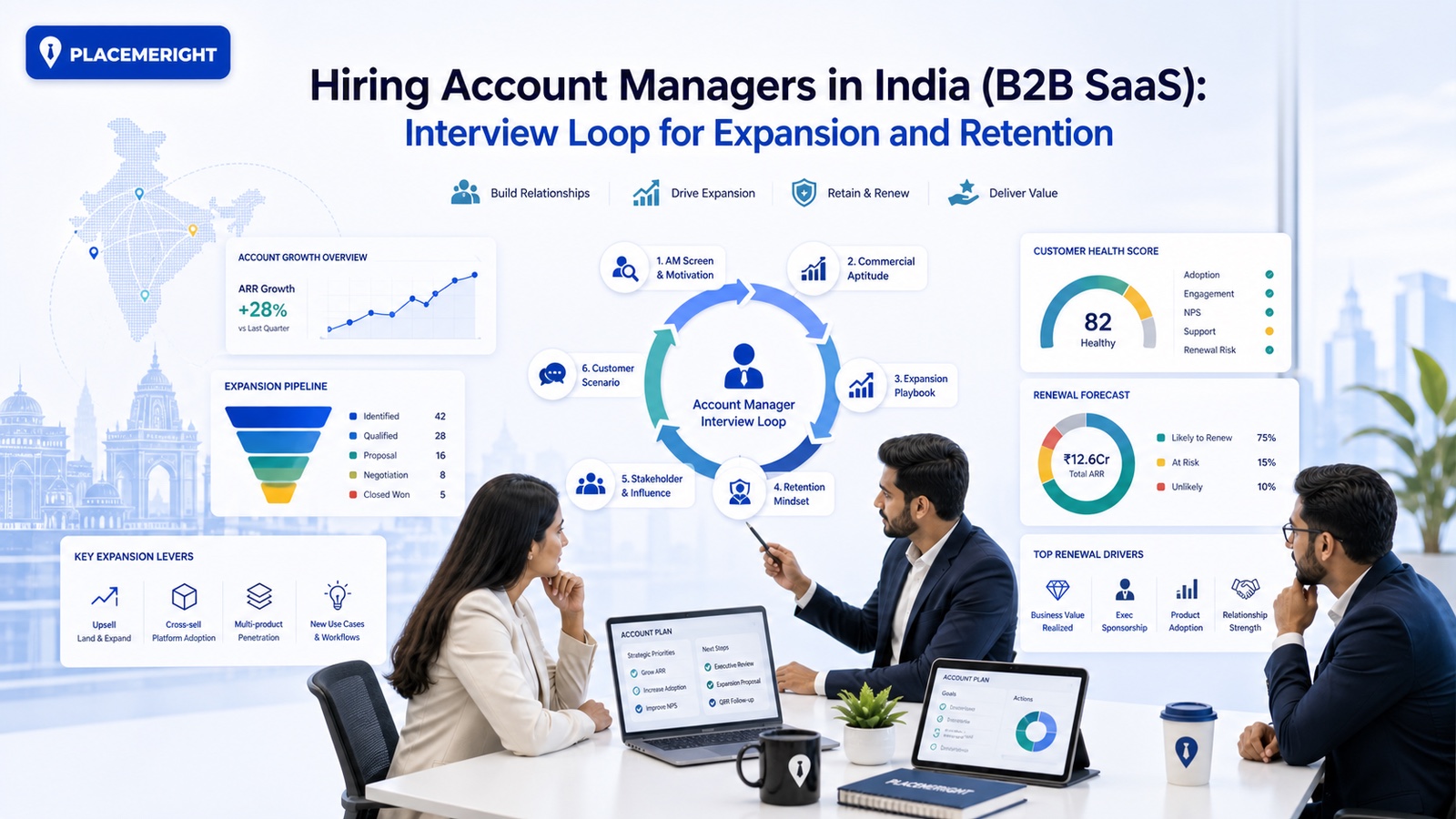
A practical interview loop (India-ready)
Use a structured loop that is fast to run and hard to game:
Round 1: Screen (45 minutes)
- Ask for a shipped feature where expansion playbooks mattered and what could have gone wrong.
- Probe for retention discipline habits and production debugging stories.
- Assess communication: scope trade-offs under a deadline.
Round 2: Role-relevant case (60 minutes)
- Design a scenario to test forecasting rigor with constraints and edge cases.
- Ask for risks, validation steps, and rollout/rollback criteria.
- Score judgment and clarity, not memorization.
Round 3: Quality + ownership (45 minutes)
- Ask for testing strategy, monitoring plan, and post-release verification.
- Score practical rigor and ability to prioritize.
Work sample (30–60 minutes) that predicts real work
Keep the task short, job-real, and scorable:
- Draft a short design doc covering expansion playbooks trade-offs and risks.
- List 10 edge cases and validations tied to retention discipline.
- Write a release checklist and rollback criteria for forecasting rigor.
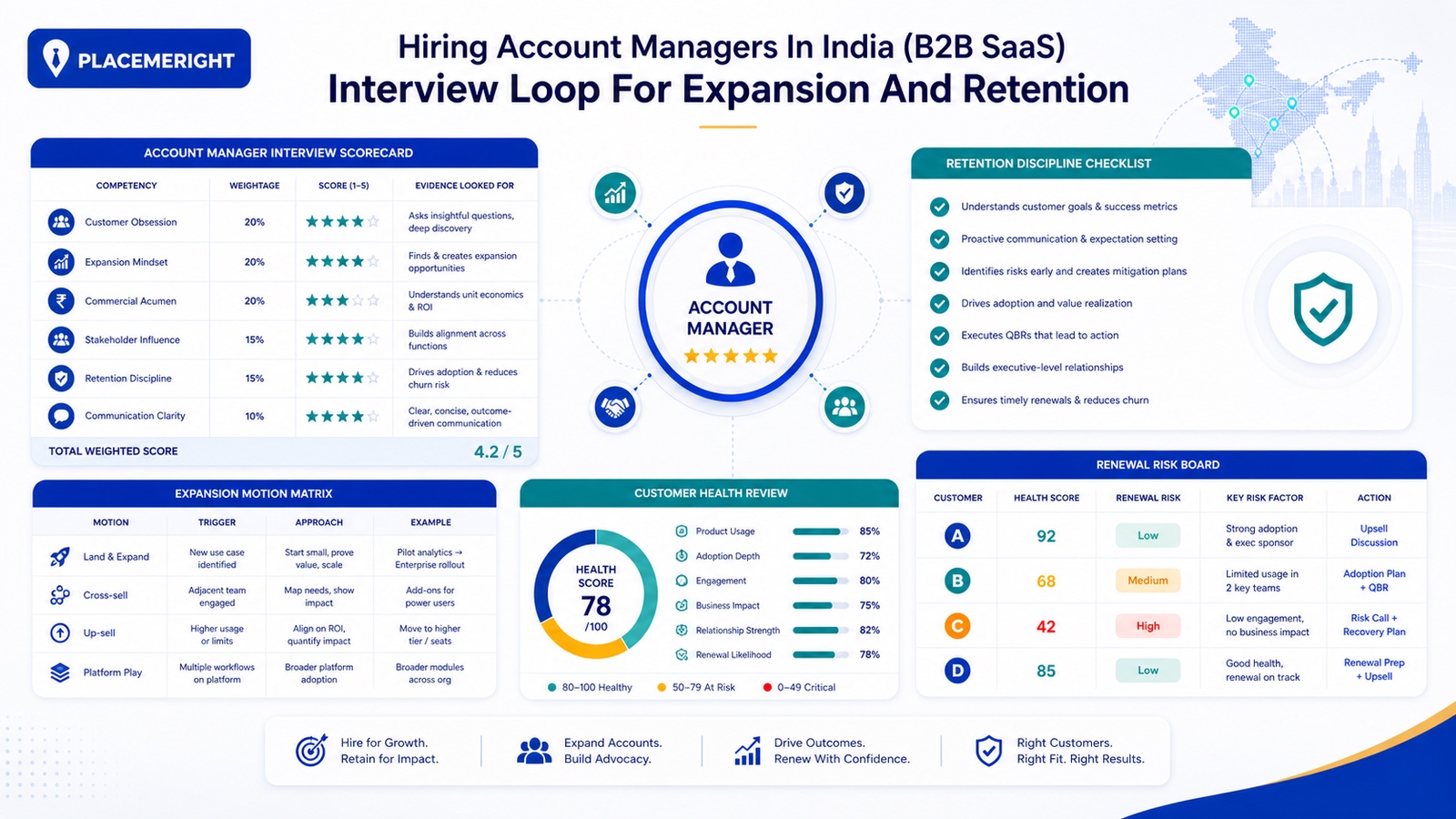
Scorecard (copy/paste)
Rate each bucket: Strong / Acceptable / Risk.
1. Role judgment (trade-offs, correctness, safety) 2. Quality discipline (tests, reviews, rollout thinking) 3. Debugging and ownership (hypotheses, data, incidents) 4. Communication (scope, clarity, collaboration) 5. Practical delivery (shipping, prioritization, risk handling)
Common mistakes that slow hiring (and how to avoid them)
1. Overweighting buzzwords and underweighting ownership stories. 2. No consistent rubric—interviewers improvise and outcomes become random. 3. Skipping job-real scenarios—false positives slip through. 4. Not communicating timelines and next steps—candidates drop out.
Quick checklist (copy/paste)
- Confirm the role charter (outcomes, scope, stakeholders).
- Define 5–7 signals to test (must-haves vs trainable).
- Run a consistent loop (same questions, same scoring).
- Use a scorecard with clear pass/fail thresholds.
- Keep the process fast (time-box rounds; avoid extra rounds).
- Track funnel metrics (time-to-interview, pass-through, offer acceptance).
Interview question bank (copy/paste)
Use these prompts to quickly test real-world signals (not trivia):
- Tell me about a project where expansion playbooks trade-offs were painful. What did you choose and why?
- How do you design for retention discipline without slowing shipping?
- Walk through a production bug related to forecasting rigor. What was your triage path?
- How do you define rollback criteria before shipping?
- What does a great code review look like in your opinion?
- How do you prevent flaky tests or over-testing from killing velocity?
- How do you communicate risk to non-technical stakeholders?
- What would you do in your first 30 days to reduce incidents and improve delivery?
Related reading
If you’re improving hiring outcomes, these related guides can help:
- Hiring Sales Development Managers in India: Screening for Process, Coaching, and Pipeline Quality
- Hiring ATS Administrators in India: Interview Signals for Data Hygiene and Workflow Governance
- Hiring Recruitment Coordinators in India: Screening for Scheduling SLAs and Candidate Experience
- Hiring Talent Acquisition Leaders in India: Interview Loop for Strategy, Metrics, and Stakeholder Management
- Hiring Employer Branding Managers in India: Screening for Credibility and Conversion
- Hiring Onboarding Specialists in India: Interview Signals for Day-1 Readiness and Adoption
FAQs
Do Account Managers (B2B SaaS) candidates need deep system design?
Only if the role demands it. For most teams, practical ownership—trade-offs, debugging, testing, and safe rollout discipline—predicts performance better than abstract design trivia.
How do we reduce false positives?
Use structured scenarios + scorecards. Ask for trade-offs, edge cases, and rollback criteria. Keep the loop consistent across candidates. For Account Managers roles, ask for one concrete example (a shipped project, an incident/post-mortem, or a measurable improvement) and then probe constraints, trade-offs, and validation steps. This forces specificity and reduces false positives.
Conclusion
Better hiring outcomes come from clarity: define what “good” means, test it directly with scenarios, and score consistently. You’ll reduce false positives and speed up offers—without lowering the bar.
CTA (PlaceMeRight)
If you’re hiring in India and want faster shortlists with structured screening and clear interview operations, PlaceMeRight can help.
- Talk to us: Contact
- Explore tech hiring: Tech recruitment and IT recruitment agency in India
- For embedded hiring pods: RPO services
References
- https://developers.google.com/search/docs/fundamentals/creating-helpful-content
- https://owasp.org/www-project-top-ten/
- https://sre.google/sre-book/table-of-contents/
- https://itrevolution.com/product/accelerate/
Tags:
Misri Soni
PlaceMeRight recruitment insights