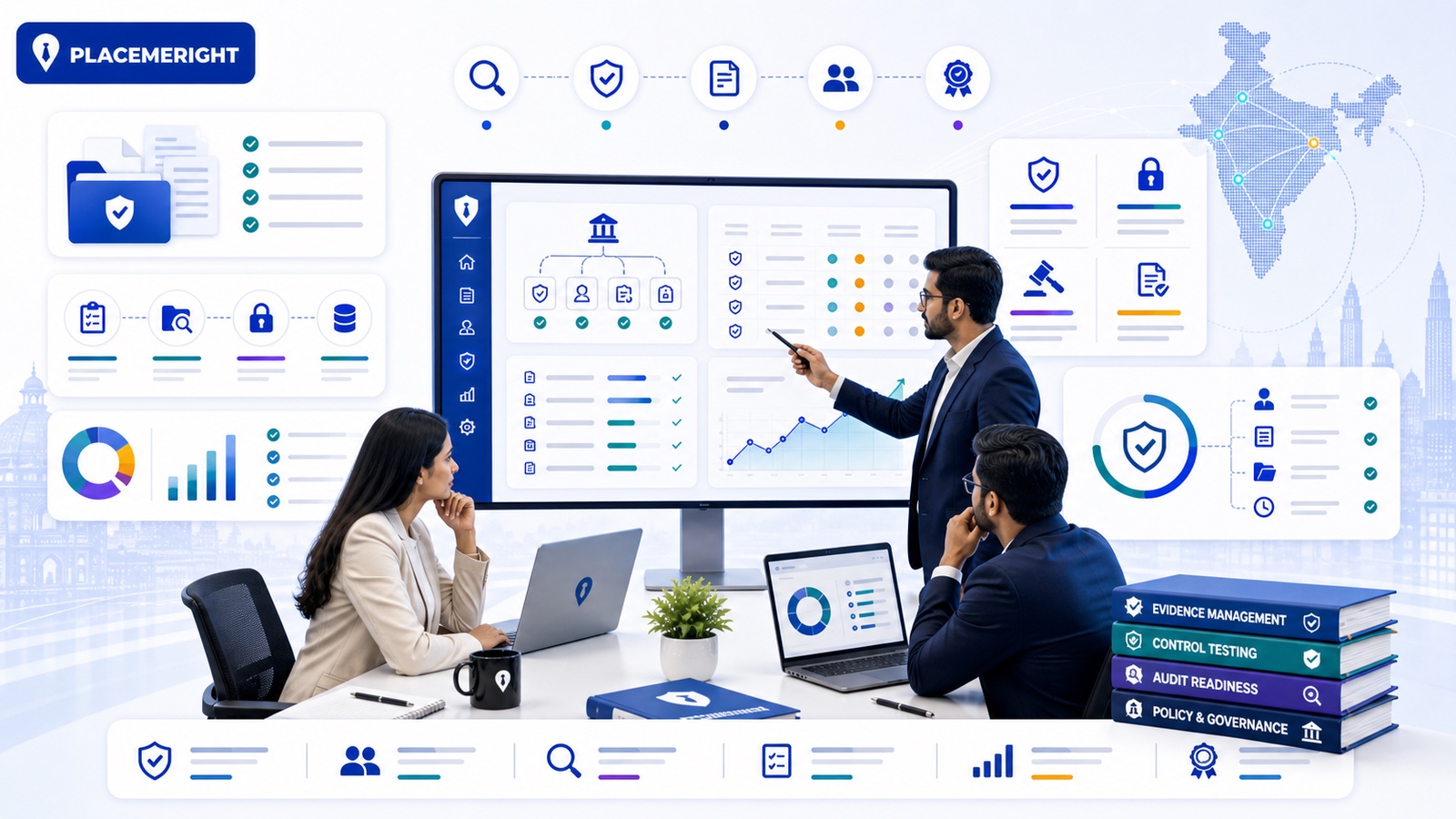
Why this role is hard to hire well (and why it matters now)
Hiring Compliance Analysts is rarely about checking tools on a resume. The real signal is whether a candidate can make trade-offs under pressure and still deliver predictable outcomes—especially around audit readiness. This section helps you separate confident storytelling from production-grade judgment so you can shortlist faster and reduce bad hires.
If you want help improving shortlist quality and interview speed, explore RPO services and learn more about PlaceMeRight on About. For end-to-end hiring support, see Tech recruitment and our IT recruitment agency in India.
What you’re really hiring for
You’re hiring outcomes, not tasks. Strong candidates can:
- explain what they owned (not “team did”)
- make trade-offs with evidence
- communicate risk early and reduce rework
Shortlisting signals (what good looks like)
Must-have signals
- Can explain evidence quality decisions with evidence and clear risk trade-offs.
- Uses a repeatable process for controls discipline (not tool tours).
- Communicates incidents and escalations clearly to stakeholders.
- Writes auditable documentation for controls and remediation.
Strong signals
- Has examples where audit readiness reduced repeat incidents or risk.
- Can balance security and delivery without blocking teams.
- Understands vendor risk and third-party dependencies.
- Can run postmortems that lead to measurable fixes.
Red flags
- Only talks tools; cannot explain outcomes or judgment.
- No story of preventing recurrence—only firefighting.
- Avoids ownership: “someone else handled it.”
- Cannot write a concise stakeholder update under pressure.
A practical interview loop (India-ready)
Use a structured loop that is fast to run and hard to game:
Round 1: Screen (30–40 minutes)
- Ask for one real incident related to evidence quality and what changed after.
- Probe for first 10 minutes of triage: data points, containment, comms update.
- Assess writing clarity: a 3-line stakeholder update.
Round 2: Scenario simulation (45–60 minutes)
- Give a short timeline + logs + alerts tied to controls discipline.
- Ask for hypotheses, containment decision, and next actions.
- Score evidence use, prioritization, and calm communication.
Round 3: Program design (45 minutes)
- Design a 90-day plan to improve audit readiness: controls, owners, metrics, cadence.
- Score practicality and measurable outcomes (not buzzwords).
Work sample (30–60 minutes) that predicts real work
Keep the task short, job-real, and scorable:
- Write a 1-page response plan for a evidence quality incident (containment + comms + follow-ups).
- Triage an alert bundle and propose fixes to improve controls discipline quality.
- Propose a 30-day plan with 3 measurable outcomes to reduce audit readiness.
Scorecard (copy/paste)
Rate each bucket: Strong / Acceptable / Risk.
1. Triage judgment (severity, containment, prioritization) 2. Communication (stakeholder updates, clarity under pressure) 3. Investigation rigor (evidence, hypotheses, verification) 4. Prevention mindset (reducing recurrence, measurable fixes) 5. Collaboration (engineering, leadership, vendors)
Common mistakes that slow hiring (and how to avoid them)
1. Overweighting buzzwords and underweighting ownership stories. 2. No consistent rubric—interviewers improvise and outcomes become random. 3. Skipping job-real scenarios—false positives slip through. 4. Not communicating timelines and next steps—candidates drop out.
Quick checklist (copy/paste)
- Confirm the role charter (outcomes, scope, stakeholders).
- Define 5–7 signals to test (must-haves vs trainable).
- Run a consistent loop (same questions, same scoring).
- Use a scorecard with clear pass/fail thresholds.
- Keep the process fast (time-box rounds; avoid extra rounds).
- Track funnel metrics (time-to-interview, pass-through, offer acceptance).
Interview question bank (copy/paste)
Use these prompts to quickly test real-world signals (not trivia):
- Tell me about a real evidence quality incident you handled. What changed after?
- How do you decide severity and containment when controls discipline signals are noisy?
- Write a 3-line stakeholder update during an incident: impact, action, next update time.
- What are your top 5 prevention actions to reduce audit readiness in 30 days?
- How do you balance security gates with delivery speed without rubber-stamping risk?
- Describe a time you challenged a risky request. What alternative did you propose?
- How do you measure if your detection program is improving (false positives vs misses)?
- What evidence do you keep so audits don’t become a last-minute scramble?
Related reading
If you’re improving hiring outcomes, these related guides can help:
- Hiring Risk Analysts in India (Tech): Interview Loop for Risk Registers and Prioritization
- Hiring Vendor Risk Managers in India: Screening for Assessments and Practical Remediation
- Hiring Data Privacy Engineers in India: Interview Signals for Consent and Data Minimization
- Hiring Site Reliability Engineering Managers in India: Interview Loop for SLOs and On-Call Culture
- Hiring Platform Engineering Managers in India: Screening for IDPs and Adoption Metrics
- Hiring Engineering Productivity Leads in India: Interview Signals for DevEx and Cycle Time
FAQs
Do we need deep tool expertise for this role?
Tools help, but the differentiator is judgment: triage, communication, and prevention. Strong candidates can learn new stacks fast. For Compliance Analysts roles, ask for one concrete example (a shipped project, an incident/post-mortem, or a measurable improvement) and then probe constraints, trade-offs, and validation steps. This forces specificity and reduces false positives.
How do we keep security interviews fair?
Use scenarios with limited inputs and score reasoning + communication. Avoid trivia-heavy quizzes that don’t predict on-call performance. For Compliance Analysts roles, ask for one concrete example (a shipped project, an incident/post-mortem, or a measurable improvement) and then probe constraints, trade-offs, and validation steps. This forces specificity and reduces false positives.
Conclusion
Better hiring outcomes come from clarity: define what “good” means, test it directly with scenarios, and score consistently. You’ll reduce false positives and speed up offers—without lowering the bar.
CTA (PlaceMeRight)
If you’re hiring in India and want faster shortlists with structured screening and clear interview operations, PlaceMeRight can help.
- Talk to us: Contact
- Explore tech hiring: Tech recruitment and IT recruitment agency in India
- For embedded hiring pods: RPO services
References
- https://developers.google.com/search/docs/fundamentals/creating-helpful-content
- https://owasp.org/www-project-top-ten/
- https://sre.google/sre-book/table-of-contents/
- https://itrevolution.com/product/accelerate/
Tags:
